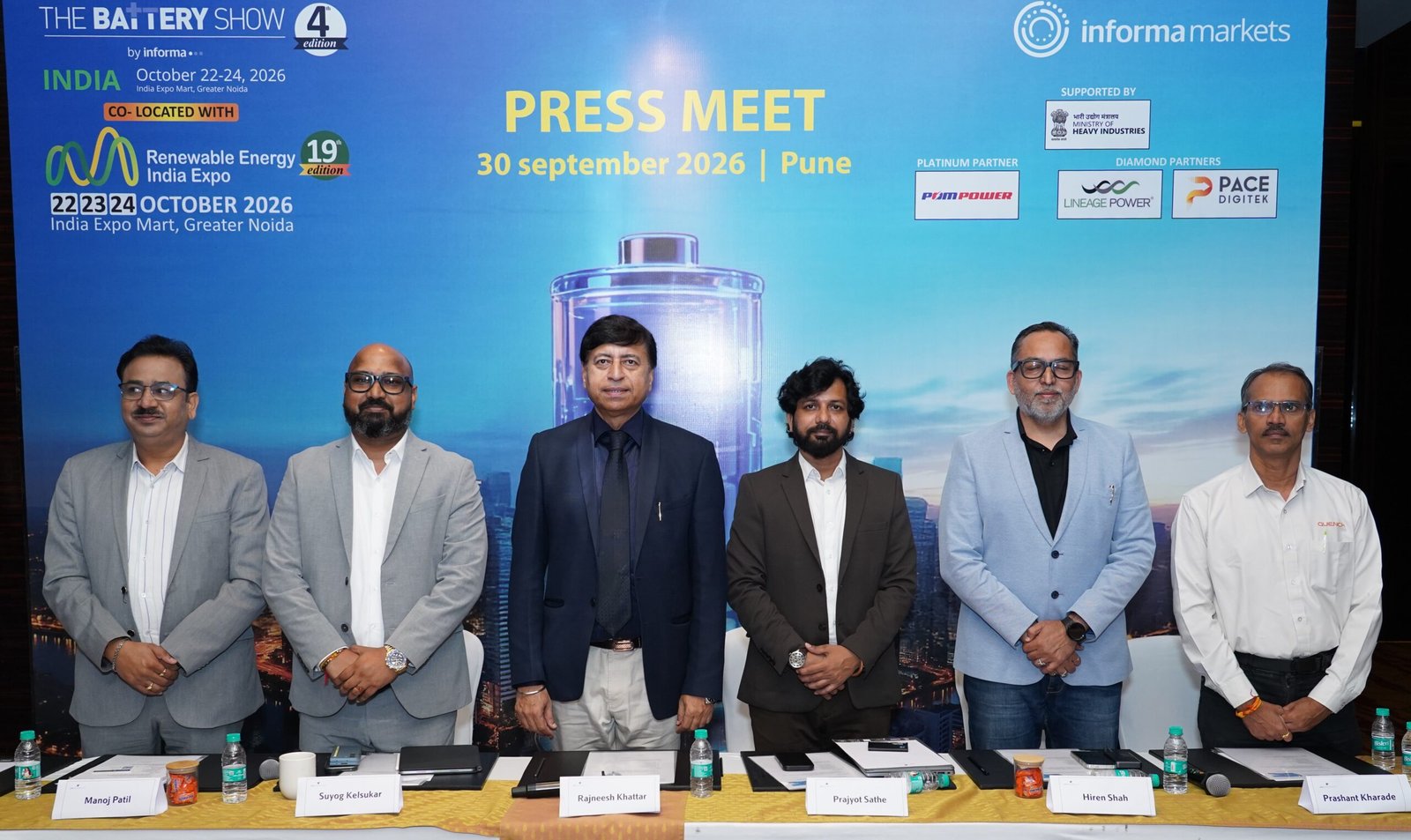
A recent industry roundtable in Pune has brought together leaders from the electric vehicle, battery manufacturing, energy storage, automation and mobility sectors to discuss India’s evolving battery ecosystem ahead of the fourth edition of The Battery Show India 2026, scheduled from October 22 to 24 at India Expo Mart, Greater Noida.
During the roundtable, industry experts said India’s battery electric passenger car market is expected to reach around 1.8 lakh to 1.9 lakh units in 2026. The market stood at approximately 1.78 lakh units in 2025, compared with around 99,000 units in 2024.
Prajyot Sathe, Research Director – Mobility – Electric Vehicles, Frost & Sullivan, said India’s EV market has progressed from an early-stage segment to one supported by stronger policy, regulation and increasing adoption. He noted that electrification has expanded from two-wheelers and three-wheelers to light commercial vehicles and buses, while passenger cars are developing at a later stage.
Sathe expects annual passenger EV sales to reach around 1.5 million units by 2032. He also said the next phase of the market will be influenced by advanced battery technologies, supply-chain localisation and interoperable charging infrastructure. LFP has emerged as the dominant chemistry, while sodium-ion, lithium-sulphur and solid-state technologies are being explored for future applications.
The roundtable also highlighted the need to deepen domestic manufacturing capabilities. Component localisation is currently estimated at around 50–60 per cent and could rise to 80–90 per cent over the next five to six years, although battery and power electronics localisation is expected to remain below 60 per cent.
Suyog Keluskar, Senior Director, 1Lattice, said India’s energy transition is increasingly moving beyond vehicle adoption towards a wider infrastructure opportunity. He pointed to growing EV penetration and the rising share of electric commercial vehicles as signs that fleet operators are increasingly assessing electric mobility through total cost of ownership.
Keluskar also highlighted the projected increase in advanced cell demand, which could rise from around 28 GWh in 2025 to approximately 272 GWh by FY30. He added that the grid could require around 236 GWh of battery storage by FY32, underlining the need to accelerate domestic cell manufacturing and battery storage deployment.
Battery energy storage systems also emerged as a key area of growth. Hiren Shah, Managing Director & CEO, Replus Engitech, said the company is deploying 1.2 GWh across applications including firm and dispatchable renewable energy, round-the-clock power, solar-plus-storage, standalone BESS and transmission and distribution projects.
Replus currently has 1 GWh of manufacturing capacity and is scaling this to 6 GWh, with the additional facility expected to become operational from January 2027. The company is also developing storage solutions for commercial and industrial applications, data centres, residential users and EVs.
Automation was another major theme at the Pune discussion, with industry participants highlighting its role in improving manufacturing efficiency, safety and traceability. Manoj Patil, Chairman & Managing Director, Patil Automation Ltd., said domestic automation capabilities are becoming increasingly important as battery production expands across vehicle segments and energy storage applications.
Patil Automation is working on automated production lines for cells, modules and battery packs, with manufacturing systems designed to capture data across production stages. The company has completed 10–15 fully automated base lines over the past two to three years and is currently executing more than 15 additional base lines.
Prashant Kharade, Chief Operating Officer, Ador Digatron, highlighted the importance of domestic battery testing, EV charging, power conversion and energy management capabilities. The company has expanded its battery technology portfolio from lead-acid to lithium-ion applications and recently introduced PCS solutions for energy storage.
Kharade said combining batteries manufactured in India with domestic PCS and EMS capabilities could help reduce external supply dependencies and strengthen the country’s energy storage ecosystem.
The roundtable also highlighted Pune’s established automotive and engineering base as an important advantage for India’s EV transition. The Pimpri-Chinchwad region has more than 4,000 automotive and ancillary units, supported by R&D, testing and certification facilities. Maharashtra’s EV Policy 2025 also identifies Pune for potential Centres of Excellence covering EVs, charging infrastructure and hydrogen technologies, along with strategic EV battery recycling hubs.
Rajneesh Khattar, Senior Group Director, Informa Markets in India, said the expansion of electric mobility is creating a need for stronger domestic capabilities across cells, battery management systems, power electronics, testing, safety, recycling and energy storage.
The discussions in Pune are expected to feed into wider industry conversations at The Battery Show India 2026, which will bring together companies and technology providers from across the battery, EV, energy storage, automation and manufacturing value chain.
Send news announcements/press releases to:
jeevika@thefoundermedia.in