
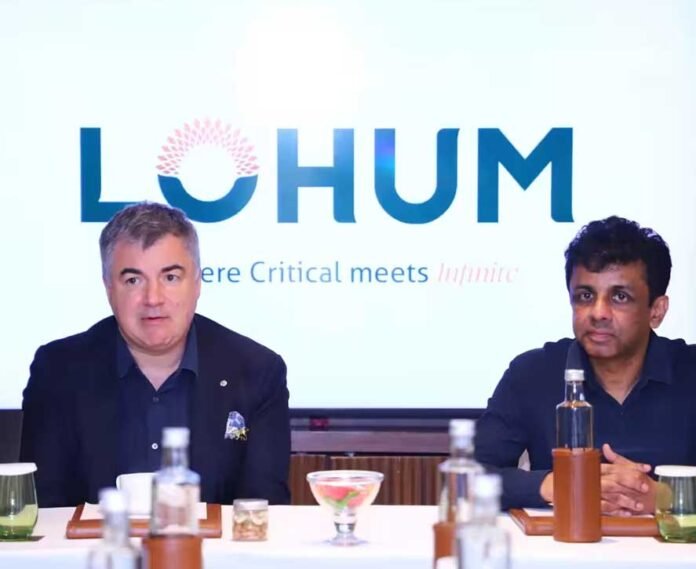
LOHUM has appointed Nobel Laureate Professor Sir Konstantin Novoselov as Chief Scientist of its new deep-tech incubation and venture platform, aimed at accelerating advanced materials research and translating scientific discoveries into commercially viable industrial technologies.
LOHUM has appointed Professor Sir Konstantin Novoselov, Nobel Laureate in Physics (2010), as Chief Scientist of its newly established deep-tech incubation and venture platform focused on advanced materials.
The appointment marks an important development at the intersection of scientific research, deep-tech innovation and industrial manufacturing. The initiative aims to address a key challenge in advanced materials development: translating promising laboratory research into commercially viable technologies that can eventually be manufactured at scale.
Novoselov shared the 2010 Nobel Prize in Physics with Professor Andre Geim for their pioneering experiments on graphene, a material that has attracted significant scientific and industrial interest because of its distinctive electrical, mechanical and thermal properties.
Bridging Scientific Research and Industrial Applications
The platform is designed to accelerate the journey of emerging technologies from early-stage research towards industrial commercialisation.
Technologies at Technology Readiness Levels (TRL) 1–4 generally represent fundamental research, proof of concept and early laboratory validation. Moving towards TRL 7–8 involves demonstration and validation in relevant operational environments.
LOHUM aims to support this transition through scientific expertise, capital, infrastructure and manufacturing capabilities. The platform’s approach is intended to connect research and intellectual property development with commercialisation opportunities.
By bringing together scientific research and industrial resources, the initiative seeks to create a stronger pathway for advanced technologies to move from laboratories towards practical applications.
Focus on Critical Minerals and Next-Generation Materials
The platform is evaluating potential areas of focus, which include:
- Strategic and Critical Minerals: Exploring materials that are essential to advanced manufacturing, energy technologies and industrial supply chains.
- Nanomaterials and Two-Dimensional Structures: Examining emerging materials and their potential applications across next-generation technologies.
- Advanced Magnetic Materials: Exploring material innovations with potential applications in industrial, electronic and energy-related technologies.
These are areas under consideration, rather than confirmed commercial product applications. The company’s final focus areas are expected to be announced following the platform’s assessment.
The initiative reflects an effort to connect scientific expertise with industrial development and build capabilities that can support the commercialisation of advanced materials.
Why It Matters for the Automotive and EV Industry
The development also carries relevance for the automotive sector, particularly as the industry moves towards electrification, intelligent mobility and advanced manufacturing.
Critical minerals and advanced materials play an important role in the evolving electric vehicle ecosystem. Battery technologies, energy storage systems, power electronics, electric motors and lightweight vehicle components all depend on material innovation and reliable supply chains.
Research into nanomaterials and two-dimensional structures could also create future opportunities in electronics, thermal management, sensing and other advanced technology applications. However, their suitability for specific automotive applications will depend on further research, testing and industrial validation.
For India’s automotive and EV ecosystem, initiatives that connect scientific research with manufacturing capabilities could contribute to domestic technology development and strengthen the broader advanced-materials supply chain.
Strengthening India’s Deep-Tech and Manufacturing Ecosystem
Building a competitive advanced manufacturing ecosystem requires more than research excellence. It also depends on the ability to fund, develop, validate and commercialise emerging technologies.
By bringing scientific leadership together with industrial infrastructure and investment, LOHUM’s platform aims to address this transition from discovery to application.
The initiative highlights the growing importance of collaboration between scientists, industry leaders, investors and manufacturing organisations in developing next-generation technologies.
The Road Ahead
The appointment of Professor Sir Konstantin Novoselov marks a significant step in LOHUM’s expansion into advanced materials research and commercialisation.
As the platform progresses with its assessment of focus areas and development priorities, its evolution will be worth watching across the critical minerals, clean energy, automotive and advanced manufacturing sectors.
The larger opportunity lies in translating scientific discoveries into scalable industrial capabilities and strengthening India’s participation in the next generation of materials and technology innovation.
Connect with The Autonaut Media:
For editorial features, leadership interviews and media collaborations, reach us at pooja@theautonautmedia.com.