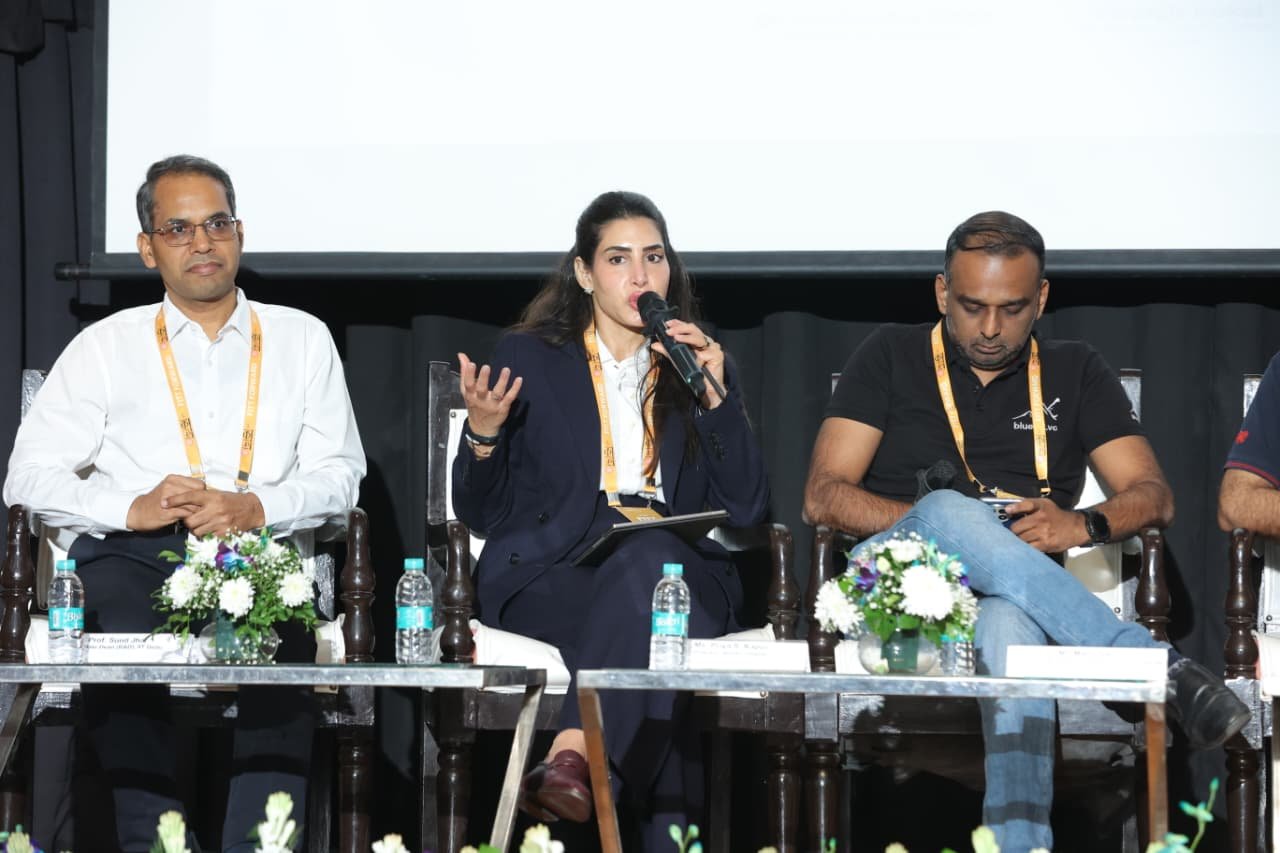
At IIT Delhi’s FITT FORWARD 2026, Priya Kapur highlighted the role of advanced manufacturing, artificial intelligence, robotics and physical AI in shaping India’s future industrial and mobility landscape.
Sona Comstar has called for deeper collaboration between industry and academia to accelerate technological innovation and strengthen India’s capabilities in advanced manufacturing and mobility.
Priya Kapur, Director and CSR Chairperson at Sona Comstar, made the remarks during a panel discussion titled “Manufacturing Tech & Semiconductors: Can India Build What the World Needs Next?” held as part of FITT FORWARD 2026 at the Indian Institute of Technology Delhi.
The discussion focused on India’s potential to build globally competitive technologies, strengthen domestic manufacturing capabilities and develop solutions that can address evolving industrial and mobility requirements.
Kapur said stronger partnerships between industry and academic institutions could help bridge the gap between research and commercial deployment. While industry contributes practical engineering challenges, manufacturing expertise and real-world use cases, academic institutions such as IIT Delhi bring deep-technology research, specialised laboratories and multidisciplinary knowledge.
“Sona Comstar’s technology focus spans advanced manufacturing, artificial intelligence, robotics, physical AI and the broader future of mobility. Strong industry-academia partnerships can connect India’s talent and research capabilities with real-world engineering challenges, enabling us to develop solutions that are relevant, scalable and globally competitive,” said Kapur.
She further emphasised that India’s next phase of manufacturing growth should extend beyond expanding production capacity and focus on building indigenous intellectual property, strengthening technological capabilities and accelerating the transition of innovations from laboratories to factory floors.
As part of its Samridh Bharat CSR Programme, Sona Comstar collaborates with the Foundation for Innovation and Technology Transfer at IIT Delhi and IIMA Ventures, the innovation and entrepreneurship centre of IIM Ahmedabad. The programme supports technology-led entrepreneurship, research and start-ups working on solutions related to mobility, sustainability and environmental challenges.
One of the key initiatives under the programme is the Innovation in Mobility Programme, implemented in partnership with FITT at IIT Delhi. Established in 2020, the programme supports deep-tech start-ups developing technologies across electric mobility, batteries, motors, hydrogen, energy storage, advanced materials and clean manufacturing.
The initiative has evolved into a broader innovation ecosystem that combines research and development support, grants, technical incubation, market access and infrastructure support. Supported start-ups have progressed from early-stage prototypes towards market readiness, developing solutions such as artificial intelligence-enabled battery systems, sodium-ion batteries, rare-earth-free motors, hydrogen technologies and mobile electric vehicle charging systems.
Kapur also highlighted the importance of industry-led research programmes, shared testing infrastructure and access to specialised laboratories in building a sustainable innovation ecosystem. Such collaborations, she noted, can help reduce technology validation timelines and support faster adoption of emerging solutions across India’s manufacturing and mobility sectors.
The company’s focus on advanced manufacturing and physical AI reflects the growing convergence of software, hardware and intelligent automation in the automotive and industrial sectors. Through continued collaboration with academic institutions and start-ups, Sona Comstar aims to contribute to the development of technologies capable of supporting India’s ambitions in global manufacturing and future mobility.
Send news announcements/press releases to:
jeevika@thefoundermedia.in