Hyundai Motor Group has accelerated its autonomous driving ambitions with the full-scale deployment of a Data Flywheel, an AI-driven development framework designed to continuously connect real-world data collection, model training, validation and vehicle deployment.
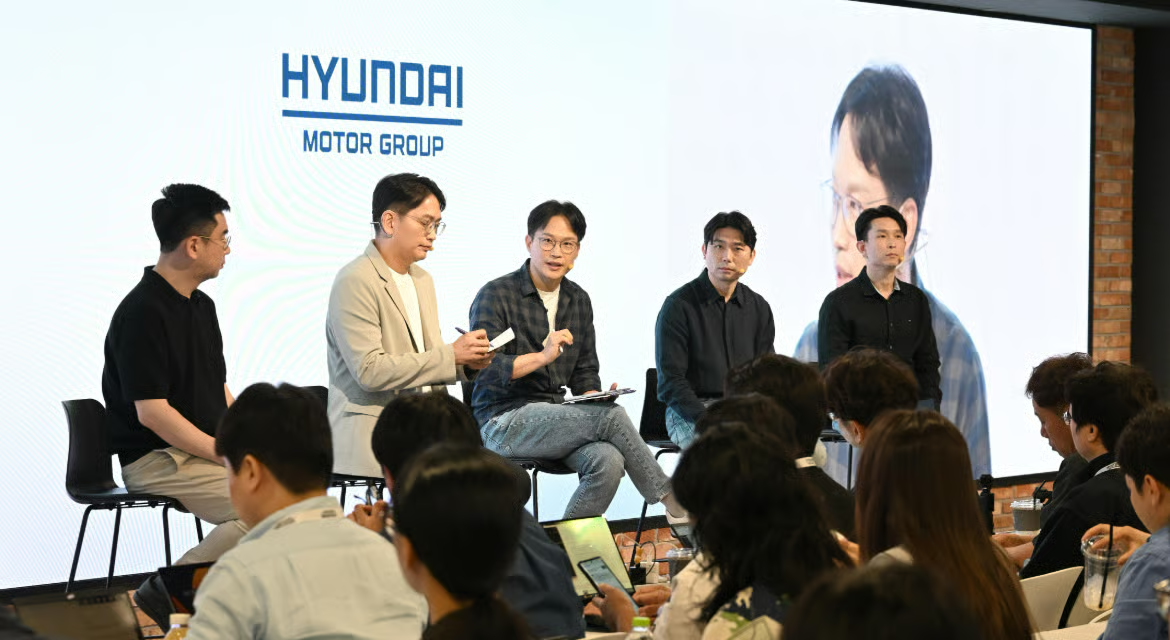
The Group outlined its autonomous driving roadmap at its HMG Autonomous Driving Media Day at 42dot headquarters in Gyeonggi Province, South Korea, highlighting a dual-track strategy that combines collaboration with NVIDIA for faster production deployment with the development of its proprietary Atria AI autonomous driving technology.
Under the first track, Hyundai Motor Group plans to introduce production vehicles equipped with NVIDIA-based Level 2+ autonomous driving capabilities in the first half of 2028, followed by Level 2++ vehicles in the second half of 2028. In parallel, the Group is developing Atria AI-powered Level 2++ vehicles, with production targeted for the second half of 2029.
The strategy is supported by progressive standardisation of sensor systems across Hyundai Motor, Kia, 42dot and Motional. By creating greater consistency in data collection and utilisation, the Group aims to strengthen the foundation for AI training, validation and autonomous driving development.
At the centre of this approach is the Data Flywheel, which enables data collected from vehicles to be used for AI training and validation before improved models are deployed back into vehicles. These deployments then generate new real-world data, creating a continuous cycle of learning and performance enhancement.
Hyundai Motor Group’s global scale provides a significant data advantage, with Hyundai Motor and Kia selling more than 7 million vehicles annually across approximately 190 countries and regions. The Group also operates around 40 dedicated data-collection vehicles around the clock to capture a broad range of driving conditions, including severe weather, road construction, sudden lane changes and complex urban traffic.
The Data Flywheel incorporates technologies such as hard example mining, continuous training, virtual validation, Special Event Recorder integration and a Follow-the-Sun development model connecting teams in South Korea and the US. The Group is also establishing a Data Union framework to enable data generated across Hyundai Motor, Kia, 42dot and Motional to be used under common standards.
Real-world validation is another key component of the strategy. Hyundai Motor Group plans to launch a Level 4 autonomous driving pilot in the Jeonnam-Gwangju Special Metropolitan City area by the end of the year in partnership with South Korea’s Ministry of Land, Infrastructure and Transport. Data from actual road conditions will be fed back into the Data Flywheel to strengthen both autonomous driving capabilities and AI development.
Meanwhile, 42dot is advancing Vision-Language-Action (VLA) technology alongside its end-to-end autonomous driving models. VLA combines visual perception, language-based reasoning and action generation, allowing autonomous systems to interpret complex situations and use reasoning to guide driving decisions. The technology is currently undergoing simulation-based validation, with real-vehicle testing and broader development planned from late 2026 through early 2027.
The Group has also released footage demonstrating Atria AI navigating Seoul’s urban roads without driver intervention. The videos feature real-world driving across congested areas, rainy conditions and complex traffic environments, alongside demonstrations of the system handling edge cases such as sudden vehicle cut-ins, roadside obstacles, unprotected turns and pedestrians in congested areas.
Speaking about the strategy, Minwoo Park, President and Head of the Advanced Vehicle Platform Division at Hyundai Motor Group and CEO of 42dot, said autonomous driving competitiveness is increasingly determined by how quickly organisations can convert data into learning, validation and improvements in actual products.
With its combination of global vehicle scale, NVIDIA collaboration, proprietary Atria AI, VLA development and the Data Flywheel, Hyundai Motor Group is positioning continuous learning as a core pillar of its autonomous driving strategy while seeking to balance faster development with safety and validation.
Send news announcements/press releases to:
jeevika@thefoundermedia.in