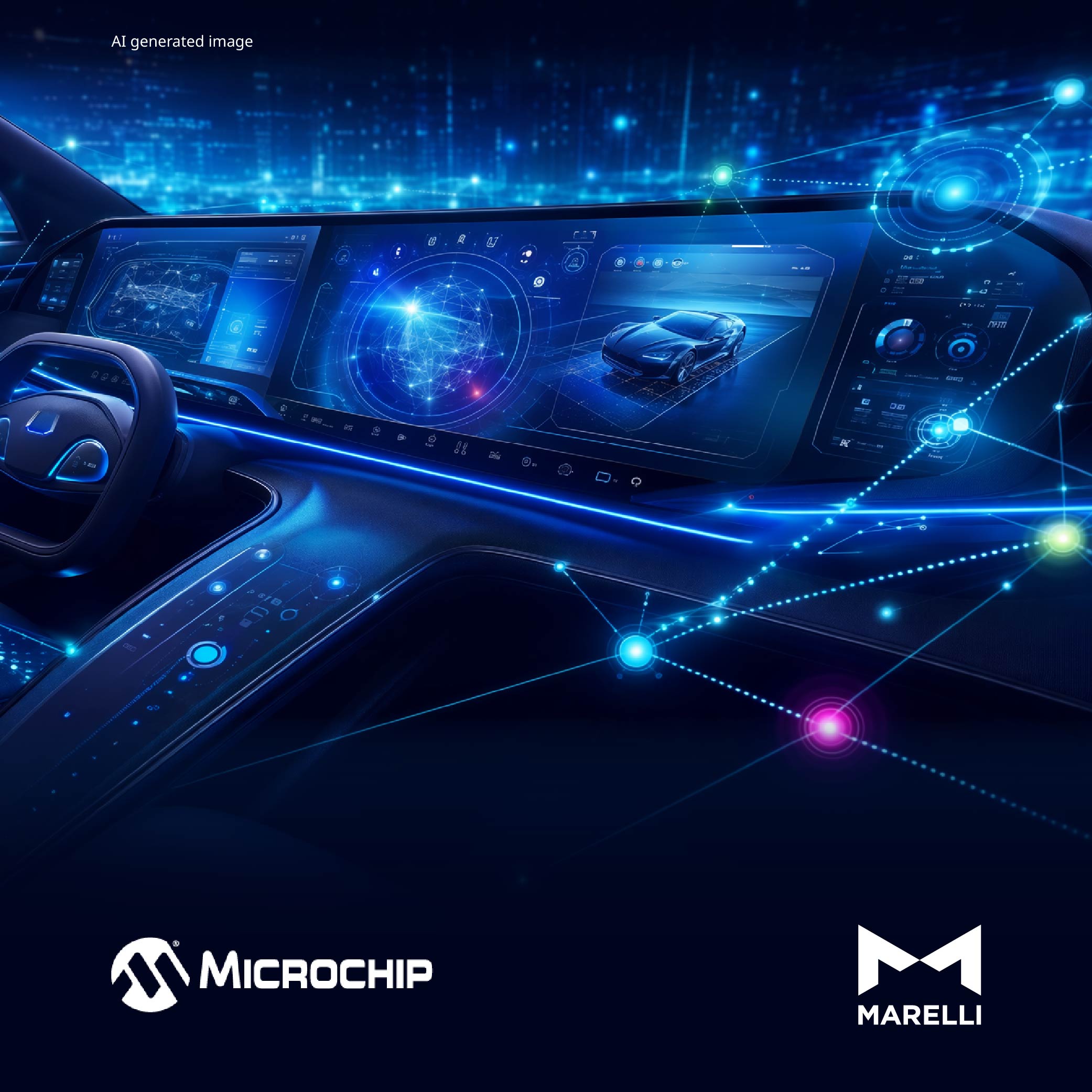
Marelli and semiconductor company Microchip Technology have announced a new connectivity solution that enables graphics and video generated by a vehicle’s central computing system to be transmitted directly to automotive displays using ASA Motion Link (ASA-ML), an open standard for automotive video connectivity.
The joint demonstrator is aimed at helping automakers simplify electronic and display architectures while managing system costs and increasing flexibility in selecting technology suppliers. The solution also supports the automotive industry’s broader transition towards software-defined vehicles (SDVs) and increasingly centralised vehicle computing.
ASA Motion Link is an open standard developed by the Automotive SerDes Alliance (ASA) for automotive video connectivity and SerDes communication. By supporting high-speed transmission across technologies from multiple suppliers, the standard is designed to improve interoperability and provide an alternative to proprietary video connectivity solutions.
As a founding member of ASA, Microchip has been working to advance open connectivity standards within the automotive sector. Its latest work extends the company’s ASA-ML capabilities from camera applications to display connectivity.
In the joint solution, graphics and video generated by the vehicle’s central computer are processed and transmitted through Microchip’s VS7000 ASA-ML chipset over a standardised high-speed connection.
Marelli contributes display-side integration by configuring and optimising the ASA-ML deserializer to decode the standardised video stream directly at the display. This enables centrally generated content such as camera feeds, navigation maps, infotainment graphics and vehicle control interfaces to be delivered accurately and synchronised at the display while reducing complexity in the display electronics.
Kelei Shen, President, Electronics Business, Marelli, said the move towards software-defined vehicles is increasing demand for electronic architectures that are more open, flexible and scalable. He added that the collaboration demonstrates how open standards can support innovation while delivering the interoperability required for next-generation vehicle architectures.
Kevin So, Vice President, Communications Business Unit, Microchip, said open standards can help accelerate automotive innovation by reducing reliance on proprietary technologies. He added that the collaboration demonstrates the potential of ASA Motion Link to provide a secure, interoperable and scalable connectivity framework for automotive manufacturers.
The technology offers several capabilities aimed at supporting future vehicle electronics architectures. These include interoperability between cockpit systems and displays from different technology providers, greater supplier flexibility and integrated link-layer authentication and encryption.
The solution also supports lossless data transmission and high immunity to electromagnetic interference, while offering scalability with data rates of up to 16 Gbps for different display requirements.
Additional efficiency features include embedded Time Division Duplex (TDD) functionality and simplified Forward Error Correction (FEC), which can contribute to reduced power consumption.
The collaboration also points towards increasingly Ethernet-centric vehicle architectures, as automakers look to centralise computing, simplify in-vehicle networking and build more scalable electronic systems.
Through the joint demonstrator, Marelli and Microchip are highlighting how open-standard connectivity can help vehicle manufacturers build more flexible and interoperable display architectures while supporting the continued evolution of software-defined vehicles.
Send news announcements/press releases to:
jeevika@thefoundermedia.in